The Donner DP-1 Guitar Power Supply review is for players who want to power several effects from one compact unit and have a mix of compatible 9V, 12V, or 18V pedals.
Its ten outputs and included cables make it a convenient board-planning option, with a few current and compatibility details worth checking first.
Donner DP-1 Review Summary
The quick verdict
7,000+ ratings
Read Amazon ReviewsDonner DP-1 Guitar Power Supply
A practical option for guitarists who want one compact supply for several 9V pedals, with dedicated 12V and 18V outputs for compatible effects.
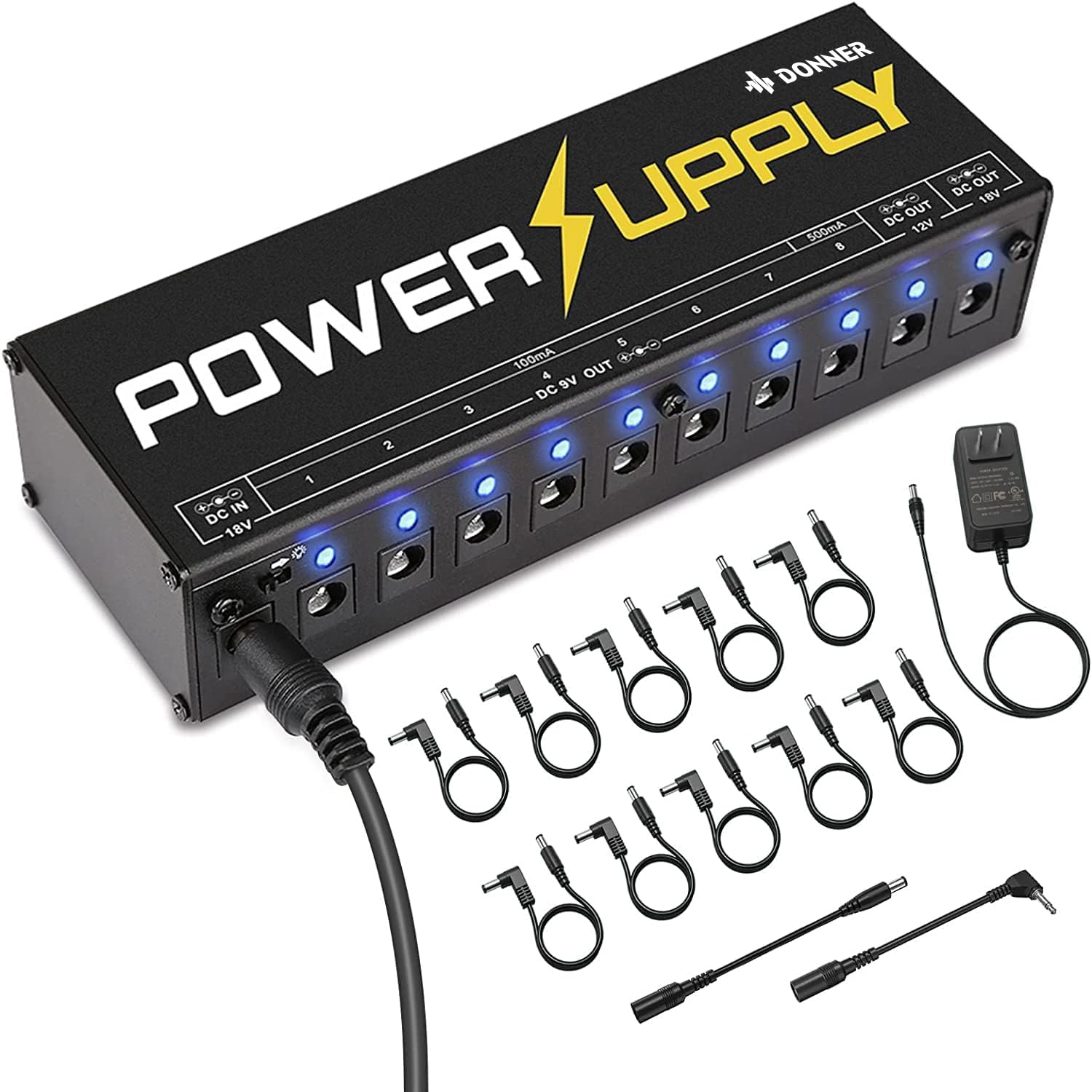
- Ten outputs: seven 9V outputs at 100mA, one 9V output at 500mA, one 12V output at 100mA, and one 18V output at 100mA.
- Independent short-circuit protection is intended to allow the other outputs to keep working if one output shorts.
- The product description identifies a noise-reduction circuit design and DC power for stable use.
- AC input is listed as 100–240V, with an 18V DC supply input to the unit.

Pros
- Ten outputs can simplify powering a multi-effect board from a single unit.
- The mix of 9V, 12V, and 18V outputs accommodates pedals that require different voltages, provided their current needs also match.
Consider before buying
- Most outputs are rated at 100mA, so buyers need to check the current draw of every pedal and ensure each assignment is suitable.
- The product description explicitly cautions that its circuit-simulation approach does not provide absolute isolation.
Read the full review summary
The DP-1 brings ten power outputs into a compact aluminum-alloy enclosure: seven 9V outputs rated at 100mA, one 9V output rated at 500mA, and one each at 12V and 18V, both rated at 100mA.
That mix can cover a varied pedalboard, while independent short-circuit protection is designed to let unaffected outputs continue working if one output encounters a short.
It is best suited to players whose pedals match the supplied voltage and current ratings and who want several connections in one place.
The stated isolation is achieved through circuit simulation and design, and the manufacturer notes that this is not absolute circuit isolation. Check each pedal’s power requirements and the board’s grounding or noise needs before choosing it.
The buying factors
Donner DP-1 Scorecard
Editorial scores reflect listed features and buyer fit; they are not laboratory measurements or customer ratings.
Output count
Ten outputs offer room to power several effects from one unit.
Voltage flexibility
The listed mix includes 9V, 12V, and 18V options.
Current flexibility
A single 9V output is rated at 500mA; the remaining outputs are rated at 100mA.
Fault containment
Independent short-circuit protection is designed to keep other outputs working if one shorts.
Board-friendly design
The compact rectangular aluminum-alloy enclosure weighs 6.9 ounces, and the package includes ten power cables.
Isolation clarity
The design aims to provide independent power through circuit simulation, with no claim of absolute circuit isolation.
Key Features and Specifications of Donner DP-1
- Ten outputs: seven 9V outputs at 100mA, one 9V output at 500mA, one 12V output at 100mA, and one 18V output at 100mA.
- Independent short-circuit protection is intended to allow the other outputs to keep working if one output shorts.
- The product description identifies a noise-reduction circuit design and DC power for stable use.
- AC input is listed as 100–240V, with an 18V DC supply input to the unit.
- The compact rectangular enclosure is made of aluminum alloy and weighs 6.9 ounces.
- A bright blue LED indicates operation and is also described as helping illuminate the pedalboard; ten power cables are included.
Pros and Cons of Donner DP-1
Pros
- Ten outputs can simplify powering a multi-effect board from a single unit.
- The mix of 9V, 12V, and 18V outputs accommodates pedals that require different voltages, provided their current needs also match.
- A dedicated 9V, 500mA output offers more current capacity than the seven 9V, 100mA outputs.
- Independent short-circuit protection is designed to limit the effect of a short on one output.
- Its lightweight aluminum-alloy enclosure and included cables make it a straightforward candidate for a compact board setup.
Consider before buying
- Most outputs are rated at 100mA, so buyers need to check the current draw of every pedal and ensure each assignment is suitable.
- The product description explicitly cautions that its circuit-simulation approach does not provide absolute isolation.
- The blue LED may be more noticeable on a dim stage or in a dark room; consider whether board lighting is useful for your setup.
Who Should Buy Donner DP-1?
Good fit
Consider the Donner DP-1 if your board has several effects with power requirements that fit its output ratings. Before buying, make a list of each pedal’s required voltage and current, then map every pedal to an output.
The single 9V, 500mA connection is the higher-current option; the other nine outputs are each rated at 100mA.
The combination of multiple outputs, three voltage levels, included cables, and independent short-circuit protection makes the unit useful for a player building a tidy, shared power setup.
Its compact, light enclosure may also suit a board where weight and space matter.
Treat the isolation language carefully: the design aims to simulate independent outputs, but the description does not promise absolute circuit isolation.
If your rig is sensitive to power-related noise, confirm the DP-1’s suitability with your specific pedals and signal chain before relying on it.
Who should skip it
Skip this unit if your pedal lineup cannot be matched to the listed output voltages and current ratings.
In particular, check pedals that draw more than 100mA and confirm whether the 500mA 9V output is sufficient for the one pedal assigned to it.
Look for another solution if absolute circuit isolation is a firm requirement. The DP-1’s own description clarifies that its circuit design does not mean absolute isolation.
How the Donner DP-1 Fits a Pedalboard
Match every pedal to an output
The DP-1’s ten-output count is useful only when the power requirements line up. Seven connections provide 9V at 100mA, one provides 9V at 500mA, and the remaining two provide 12V and 18V at 100mA each.
Check voltage and current requirements for every effect before assigning cables; the larger output count does not mean every connection has the same capacity.
Understand the isolation design
The product describes a noise-reduction circuit and independent short-circuit protection, with other outputs intended to remain operational if one shorts.
It also explains that circuit simulation and design create the isolation effect but do not amount to absolute isolation. For a board where noise behavior is critical, test the configuration with the actual pedals and signal chain.
Consider size, cables, and visibility
The 6.9-ounce aluminum-alloy enclosure is described as a compact rectangular box, and ten power cables are included.
Those details support a consolidated board setup, while the bright blue LED is intended to indicate status and provide some pedalboard lighting. Whether that light is helpful depends on how and where you use the board.
Check the power input for your setup
The input is listed for AC 100–240V and an 18V DC supply input.
That range may suit setups using different mains voltages, but check the power arrangement and connector compatibility for your location and equipment before connecting the unit.
Alternatives to Donner DP-1
No competing power supply is recommended here. The supplied option is a pedalboard mounting accessory, so compare other power supplies by output voltage, current, and isolation design.
Guitar & Bass Accessories alternative

1,000+ ratings
Read Amazon ReviewsDonner Pedalboard Pedal Tape
Choose the DP-1 when your need is electrical power for several pedals.
The tape addresses pedal mounting and has no power outputs, so it is relevant only as a separate board-setup purchase rather than a substitute for the supply.
- This product is hook-and-loop mounting tape supplied in a 2m length and 50mm width, designed to be cut to fit pedals and attached to a pedalboard.
- The DP-1 is a multi-output power supply for compatible effects, with ten power cables included.
Is Donner DP-1 Worth It?
The Donner DP-1 is worth considering for a multi-pedal board when its ten output ratings match the pedals you plan to power.
Its range of voltages, one higher-current 9V output, included cables, and independent short-circuit protection make it a practical all-in-one candidate.
Map current and voltage needs before buying, and keep the stated limits of the isolation design in mind.
If your pedals fit the ratings and absolute isolation is not essential to your setup, the DP-1 offers a compact way to organize power across several effects.
Your review at a glance
7,000+ ratings
Read Amazon ReviewsDonner DP-1 Guitar Power Supply
A practical option for guitarists who want one compact supply for several 9V pedals, with dedicated 12V and 18V outputs for compatible effects.
- Ten outputs: seven 9V outputs at 100mA, one 9V output at 500mA, one 12V output at 100mA, and one 18V output at 100mA.
- Independent short-circuit protection is intended to allow the other outputs to keep working if one output shorts.
- The product description identifies a noise-reduction circuit design and DC power for stable use.
- AC input is listed as 100–240V, with an 18V DC supply input to the unit.